Free shipping within NZ for all orders over $75

This is what hyperemesis gravidarum actually looks like, and how my husband built the thing that finally helped us cope.
If you've had Hyperemesis Gravidarium, you already know the look people give you when you try to explain it, the one that says all pregnant women feel sick, you'll be fine. So let me say the thing I needed someone to say to me early on: this is not normal and you are doing your best.
This is a personal story of strength and resilience, written by Mackenzie, Hyperemesis Gravidarum surviver. Mackenzie is based in the US and the references to medications and treatment plans may differ between countries.
How it started
Hyperemesis gravidarum (HG) affects around 1–3% of pregnancies. It's severe, relentless nausea and vomiting, and it is a world away from morning sickness. For me it arrived at about ~7 weeks and didn't let up. I stopped being able to keep anything down. Not "a rough morning." Not "a bit queasy before crackers." Anything. Water. Toast. Even heaving on my own saliva when I finally refused to eat.
At first it was the infusion center a few times a week for IV fluids, then every weekday. Then a handful of ER visits when that wasn't enough to get me through a weekend. Finally at ~9 weeks I was admitted, where my team tried what felt like every combination of medications they could think of, with very little success. I can still vividly remember retching in the bathroom while having a next steps conversation with my doctor. Eventually I was given a PICC line because I couldn’t tolerate oral medication, and we were sent home to manage half a dozen medications ourselves, multiple times a day.
That held until I was about 18 weeks pregnant. Even with the vomiting under control the nausea was constant, and the gastroparesis was so severe I could barely eat. After losing 17% of my body weight, we were admitted again, this time for six days, and I was given an NJ feeding tube. I now live with both the PICC line and the feeding tube, and I'm on the feeding pump 22 hours a day. It’s in a cute pink backpack.
"Have you tried ginger?"
I'll be honest, by the time someone is on a feeding tube and a PICC line, "have you tried ginger?" Or “Could you just up your calories?” is a hard thing to hear. We were so far past that point. I know people mean well. But when you're this deep into it, the well-meaning suggestions can make you feel even more unseen.
What actually helped was a medical team that took me seriously. Our OB team was genuinely on their game, they were consistently responsive, and willing to keep escalating until they found what worked. If you take one thing from my story: you are allowed to keep pushing until someone listens and if they won’t find someone who will.
The part no one warns you about: the tracking
Here's the thing that quietly broke us, and it wasn't the medication or even the tube. It was the managing of it all.
Right now I take Protonix in the morning, Zofran and Phenergan 3 times a day, Enoxaparin and steroids twice a day, and finally mirtazapine before bed. On top of that, my doctors wanted me to track nearly everything: how much I was urinating, bowel movements, weight, calories taken orally versus through the tube, fluid intake. All of it feels like a full-time job when you're so nauseous it feels like too much effort to turn your head.
About a week into managing both the PICC line and the feeding tube, my husband Sam and I were completely overwhelmed. We genuinely couldn't keep the meds, the timings, and the symptom tracking straight in our heads anymore.
So we looked for an app to support this, and surely one already existed right?
BloomHG
There wasn't. We looked. Everything we found covered one slice of it. Calorie apps assume you're trying to eat less and lose weight, which is almost offensive when your whole goal is to gain. Pregnancy apps don't know what a tube feed is or why you’d want to track calories. Medication apps don't understand the full picture. And the idea of juggling four or five separate apps to cover everything just made the overwhelm worse.
So Sam started building one for us. He's a developer, and he built it from our couch, between my feeds and meds.
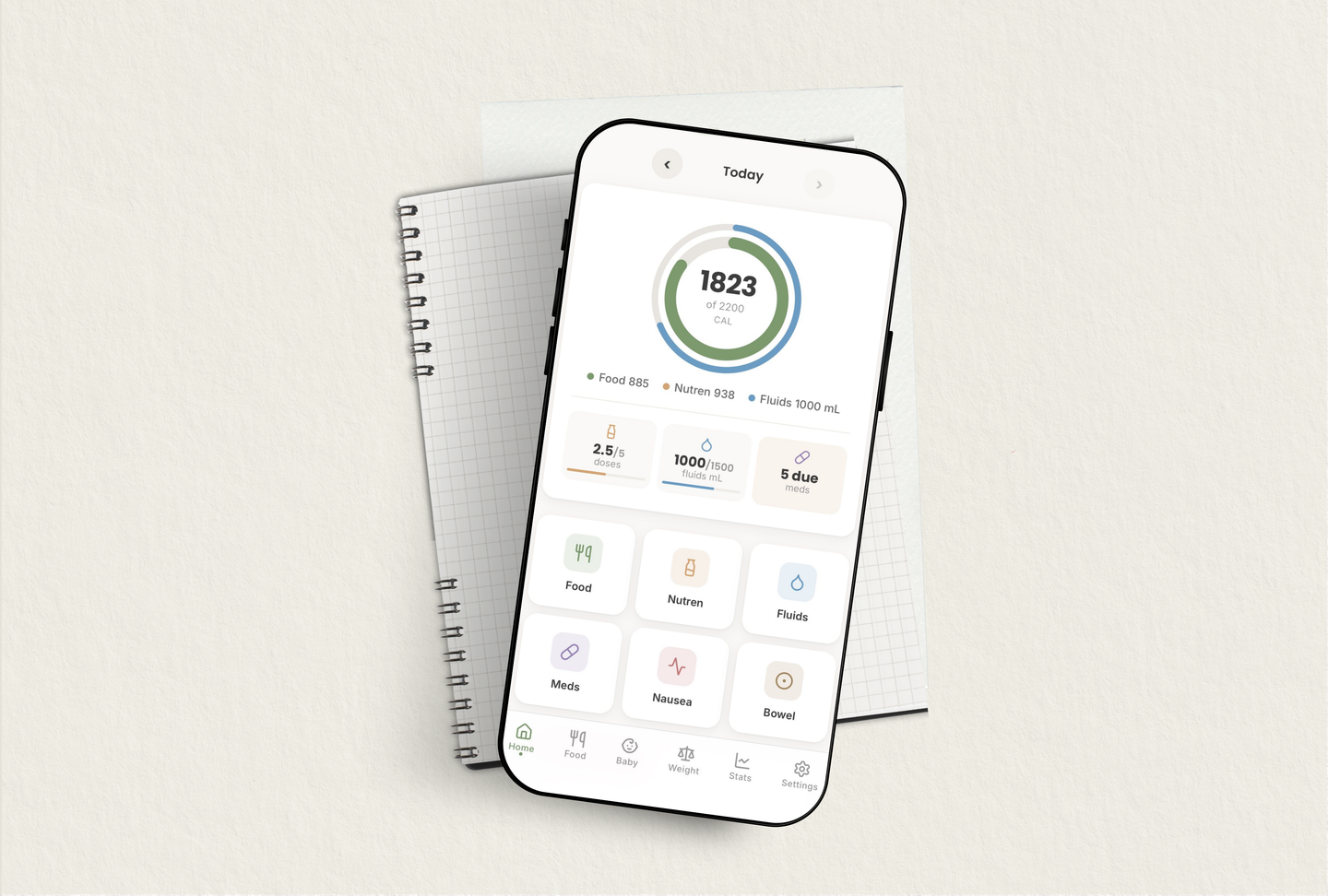
When he finished the first version, I can only describe the feeling as a weight lifting off both of us. Finally there was one place we could open and see exactly what had been tracked and what we needed to do next. No more scraps of paper, no more trying to remember if I skipped my 2pm dose or took it.
Why it's now out in the world
I shared it in an online HG support group, mostly just to say "look what my husband made me." The response was overwhelming. Almost everyone asked if they could use it too.
We never set out to build a public app. But that response made it clear: we were not alone in this. The stress of managing HG, on top of living it, is something so many families carry quietly.
So Sam spent the next week getting it ready to publish, for free, for anyone who wants it. We called it Bloom HG, and it's now available at bloomhg.app.
It tracks everything our doctors asked us to track, calories from food and tube feeds and IV nutrition, fluids, medications with proper schedules and patch rotation, nausea and vomiting, weight, and the day-to-day symptoms that matter.
If you're in the thick of it right now
I'm 22 weeks, still on the tube and the PICC line. This isn't a story with a tidy bow yet, I'm living it as I write this. But the difference between where we were and where we are now is enormous, and a lot of that came from being taken seriously, getting the right treatment, and finally having a way to manage the chaos.
If you're somewhere on the bathroom floor reading this between waves: you are not alone. There's a whole community of us. And if it helps to have one place to keep track of it all, we made you one.
With lots of love,
Mackenzie
You can learn more about Bloom HG through their website and download the app here.